Bones Do Not Have a Role In: How to Check the Options
Review skeletal functions, distinguish movement from muscle contraction, and work through negative biology questions using clear examples and checks.
Quick answer: the answer depends on the complete question
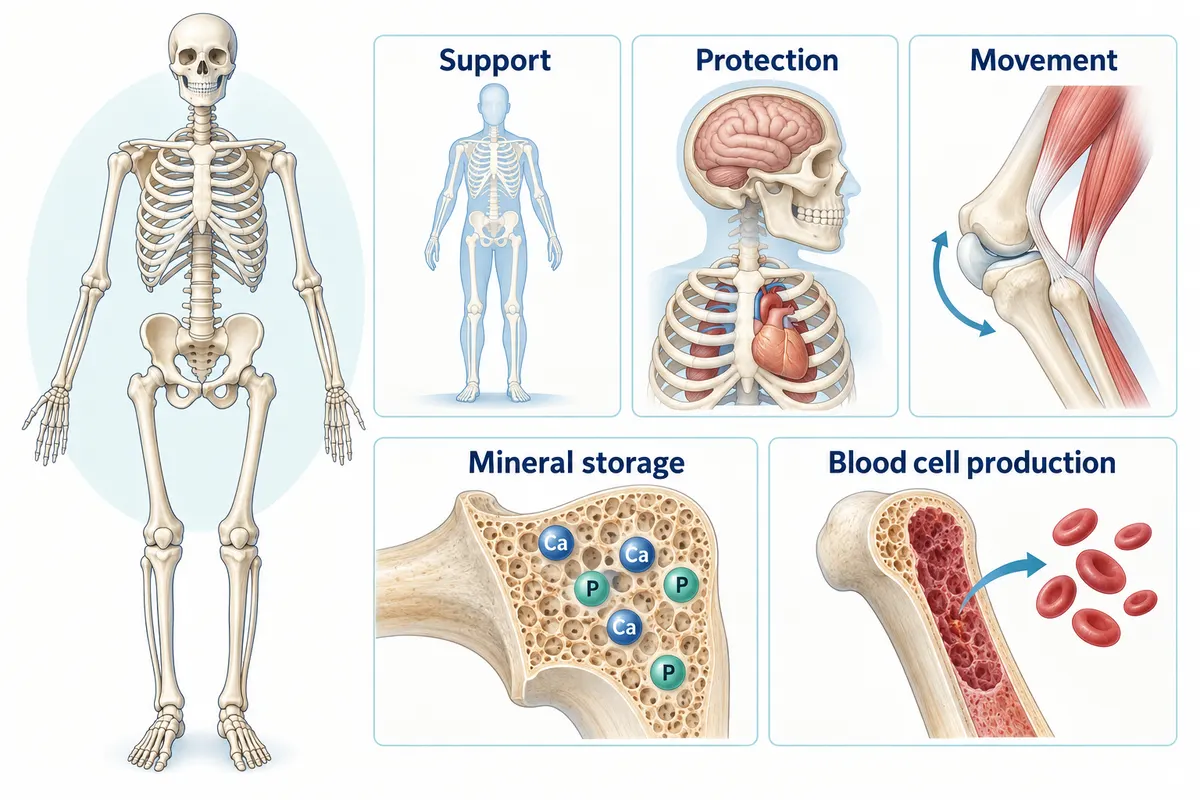
The phrase “bones do not have a role in” is an incomplete question. You need the answer choices to identify the intended exception. Start by marking support, organ protection, movement, mineral storage, and blood cell production as functions associated with the skeletal system. An option describing a different process may be the answer, but it must be checked against the wording of the question.
Do not assume that the answer is movement simply because bones do not contract. Muscles supply force, while bones provide attachment points and act as levers. Likewise, blood cell production is relevant because red marrow inside bones produces blood cells. Both are common distinctions that make a negative question harder than it first appears.
For example, if the options are support, protection, mineral storage, and making digestive enzymes, the last option is the intended exception in a basic skeletal-system question. That is an original practice example, not a claim about the answer choices on your assignment. A different set of options requires a fresh comparison.
Build a short skeletal-function checklist
Keep a compact reference beside the question. The skeletal system supports the body and protects vulnerable organs. Bones also participate in movement, store minerals such as calcium and phosphorus, and contain marrow. Red marrow produces blood cells, while yellow marrow stores fat. OpenStax’s overview of skeletal functions provides a useful reference: https://openstax.org/books/anatomy-and-physiology-2e/pages/6-1-the-functions-of-the-skeletal-system.
Use the checklist to test a choice rather than matching words mechanically. “Protection of the brain” matches protection even though it does not use the phrase skeletal function. “A reservoir of calcium” matches mineral storage. “Hematopoiesis” means blood cell production, so an unfamiliar word should not be treated as the exception just because you have not memorized it.
Write the option in familiar language before evaluating it. This is especially useful when several choices name processes and one names a structure. Your comparison should ask whether each choice describes a role, not whether all the answer choices happen to look grammatically alike.
- Support: connect the option to holding up and organizing body structures.
- Protection: look for a statement about shielding an organ or tissue.
- Movement: distinguish participation in a movement from generation of muscular force.
- Storage: identify exactly what substance the option says is stored.
- Blood cells: recognize marrow and hematopoiesis as relevant terms.
Read the verb as carefully as the noun
“Has a role in” is broader than “performs by itself.” A structure can contribute to a process without doing every step. Before choosing an answer, underline the verb: supports, produces, stores, contracts, protects, or transports. Then ask whether the entire statement is correct. A familiar noun cannot rescue an incorrect verb.
Compare two statements: “Bones help the body move” and “Bones contract to pull the body into position.” The first describes a skeletal contribution; the second assigns muscular contraction to bone. These statements concern the same broad activity but make different claims. A question about a role may accept the first while rejecting the second.
Another common trap is treating every structure inside a bone as though it had the same function. A statement about marrow is not automatically a statement about the hard mineralized matrix. Keep the level of description clear: whole organ, tissue, or particular cell type. If your course asks about bone tissue specifically, use its definition rather than silently expanding the question to the entire skeletal system.
Do the same with absolute words. “Never,” “only,” and “all” make a claim stronger. If an option contains one of them, check whether the course material actually supports that stronger claim. You do not need an obscure exception for every introductory question, but you should avoid adding certainty the question did not supply.
A five-step method for negative multiple-choice questions
First, copy the full stem and all choices. Include any diagram labels or conditions that affect the question. A cropped screenshot, an incomplete search phrase, or a missing “not” can turn a valid explanation into the answer to a different question. Check the original before spending time resolving an apparent contradiction.
Second, circle the negative word: not, except, or least likely. Rewrite the task in your own words, such as “Find the choice that is not a skeletal function.” This small step helps prevent selecting a true statement simply because it is the first familiar fact you recognize.
Third, evaluate every choice independently. Next to each, write one of three labels: supported skeletal role, different process, or unclear wording. Add a short reason rather than just a tick or cross. If two answers seem equally plausible, keep both open while you inspect their exact verbs and qualifiers.
Fourth, compare your reasons with your class reference. Look up the relevant term or section, not just the entire question copied into a search engine. This lets you explain the answer even when an online answer key uses a different order or slightly different wording.
Fifth, read your selected option back into the stem. The completed sentence should express the exception the question requested. Then explain why the other choices do fit. If that explanation breaks down, return to the choices rather than forcing your first guess to work.
- Check the full stem and preserve every answer option.
- Mark the negative instruction before deciding.
- Classify each option and write a brief reason.
- Resolve unfamiliar terms using the course reference.
- Read the completed sentence aloud and check the alternatives.
Worked practice: compare the reasons, not answer letters
Practice question 1: Bones do not have a role in which of these? A) Supporting body structures. B) Protecting internal organs. C) Acting as levers during movement. D) Producing digestive enzymes. In this set, D is the exception. A, B, and C match the skeletal-function checklist. The useful explanation is the function comparison, not memorizing the letter D.
Practice question 2: Which statement describes something bones do not do? A) Store minerals. B) Contain red marrow involved in blood cell production. C) Contract like skeletal muscle fibers. D) Provide muscle attachment points. Here, C is the exception. Notice how this question tests a particular action, contraction, while still allowing bones to participate in movement.
Practice question 3: A student rejects “blood cell production” because blood circulates in vessels. What should they recheck? They should separate the location where cells are produced from the routes along which those cells travel. A process can involve several body systems, and knowing where its product is found does not establish where it originates.
After each example, hide the explanation and write your own one-sentence justification. Then change the order of the choices and answer again. If your answer depends on remembering the original letter rather than recognizing the function, review the reasoning. This makes the practice transferable to a new question.
When the wording is ambiguous
An incomplete prompt does not have a single dependable answer. If your assignment supplies no choices, ask what type of response is expected: one example, a list of non-skeletal processes, or a distinction between two systems. State that scope in your answer. Avoid presenting a guessed completion as though it were the original question.
If more than one choice appears outside the checklist, check whether one contains a narrower claim or whether the question allows multiple answers. Record the competing interpretations in plain language. “I read role as any contribution” and “I read performs as the direct action” describe a real wording difference that a teacher can resolve.
Use a photograph of the question only to read the wording and any relevant labels. You do not need an anatomical specimen, an X-ray, or a scan of a body to answer a standard skeletal-function multiple-choice exercise. The evidence you need is the complete question and the definitions used in your course.
For your final self-check, keep three lines: the chosen option, the reason it is the exception, and the reason the strongest alternative is wrong. This creates a concise explanation you can revise if a missing word or course-specific definition changes the interpretation.
Related guides
Check the reasoning behind your biology answer
Bring the complete question and all answer choices to the Biology Homework Photo Solver: https://biologyai.app/tools/ai-biology-solver. Compare its explanation with your textbook and make sure it addresses the negative wording before using the result in your study notes.


Frequently asked questions
What is the answer to “bones do not have a role in”?
There is no unique answer without the complete question and its choices. Identify the option outside the relevant skeletal functions, then explain why the other choices fit. Do not copy a letter or answer from a different version of the question.
Do bones have a role in movement even though they do not contract?
Yes. Bones participate in movement as levers and attachment sites; muscles generate the pulling force. A question asking whether bones help movement is different from one asking whether bones contract.
Why can blood cell production be a skeletal-system function?
Red marrow within bones produces blood cells. Keep production separate from circulation: the fact that blood travels through vessels does not mean the cells originate there.
How should I handle two plausible exceptions?
Recheck the full stem, the negative word, and qualifiers such as only or directly. Compare each option with your course definitions. If both still appear defensible, describe the ambiguity to your teacher instead of inventing missing answer choices.