Mitochondrion and Mitochondria: Meaning and Function
Learn the singular and plural forms, mitochondrial structure, and ATP production, with diagram checks and worked approaches to common biology questions.
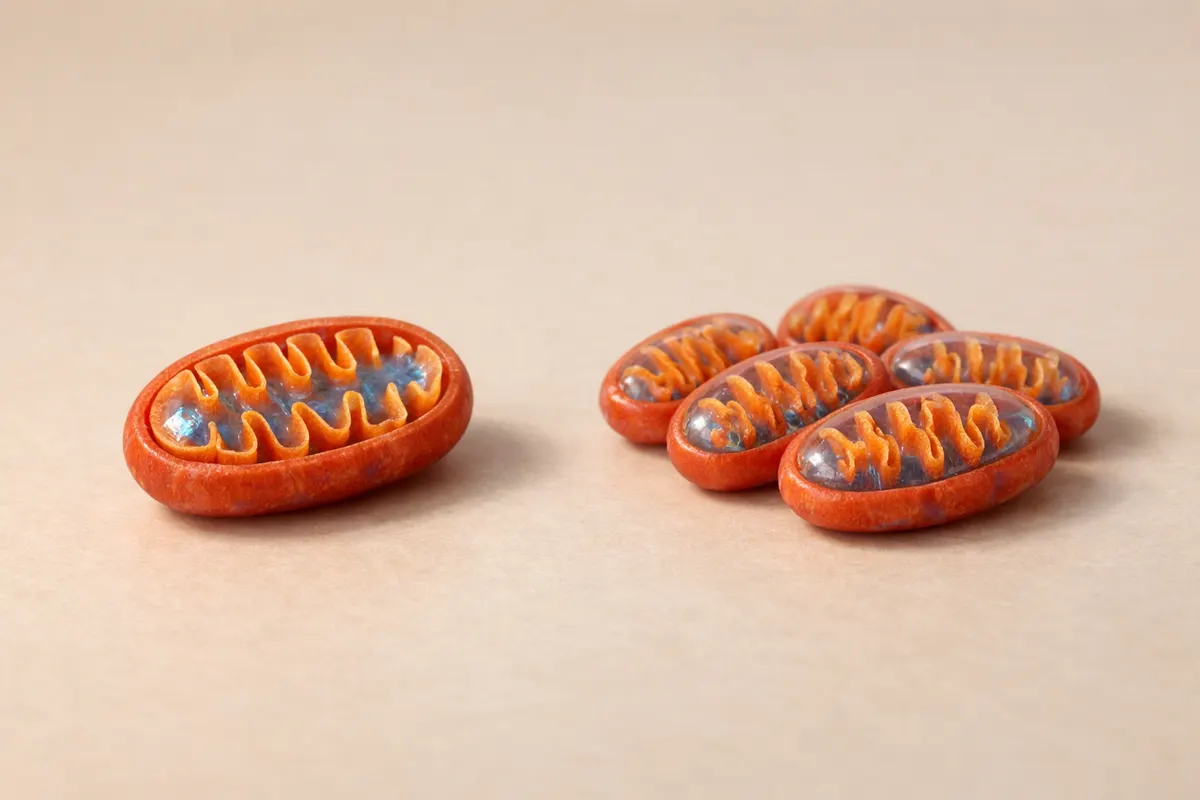
Quick answer: one mitochondrion, many mitochondria
Mitochondrion is the singular word for one organelle. Mitochondria is the plural word for two or more. They refer to the same kind of cell structure, not two different structures or different stages of a life cycle. A sentence about one should use a singular verb: a mitochondrion has an inner membrane. A sentence about several should use a plural verb: mitochondria have inner membranes. Getting that grammar right also makes your biological explanation easier to follow.
In introductory biology, mitochondria are usually discussed as important sites of aerobic respiration. They help cells make ATP, a molecule used to couple energy-releasing processes to work such as active transport, movement, and building molecules. The familiar phrase powerhouse of the cell is a memory aid, but an exam answer is stronger when it explains the process. Link respiration, ATP production, and the particular activity described in the question instead of stopping at the nickname.
Most study questions ask you to define a term, label a structure, explain a function, or interpret a comparison between cells. Decide which task you have before writing. A diagram-label question needs a location or name; a structure-and-function question needs a causal link; a comparison needs evidence from both cells. You do not need a laboratory identification workflow to learn this distinction. Start with the wording of the question and the level of detail expected in your course.
- Mitochondrion: singular; mitochondria: plural.
- Both words name the same type of organelle.
- Explain ATP production rather than relying only on a nickname.
- Read whether the question asks for a label, definition, explanation, or comparison.
Connect mitochondrial structure to its function
A typical textbook mitochondrion has an outer membrane, an inner membrane, the intermembrane space between them, and the matrix inside the inner membrane. Folds of the inner membrane are called cristae. When a question asks how the structure is suited to its function, naming these parts is only the first step. You also need to explain why their arrangement matters. For example, the folds increase inner-membrane surface area, providing space for components involved in oxidative phosphorylation.
The matrix contains enzymes involved in stages of aerobic respiration, including the citric acid cycle. The electron transport chain and ATP synthase are associated with the inner membrane. Together, these structures help explain why mitochondria feature so often in questions about energy transfer. Keep the locations distinct: saying that everything happens in the matrix loses an important part of the mechanism. Likewise, saying that cristae produce energy does not explain what the membrane-associated machinery does.
Mitochondria also contain their own DNA and ribosomes, although many of their proteins are encoded by nuclear genes and supplied through the wider cell. At school level, this can appear in questions comparing mitochondria with other organelles or introducing endosymbiotic theory. Use the features relevant to the question rather than listing every fact you remember. If the question is about ATP production, membrane organization usually matters more than a long detour into inheritance or evolutionary history.
- Outer membrane: the organelle boundary shown in a typical diagram.
- Inner membrane and cristae: the location and folded surface used in oxidative phosphorylation.
- Matrix: the internal compartment containing enzymes for important respiration reactions.
- Intermembrane space: the region between the outer and inner membranes.
Read a mitochondrion diagram without guessing
Begin with the overall outline and follow each label line to its endpoint. A line pointing to the outer boundary is different from one pointing to a fold of the inner membrane. A line ending in the internal space may indicate the matrix rather than the cristae. Students often know all the vocabulary but lose accuracy because they name the nearest familiar shape instead of checking exactly where the arrow ends. Trace the line slowly before choosing a label.
Treat textbook shapes as simplified models. Mitochondria are often drawn as bean-shaped objects with regular internal folds because that makes the main structures easy to teach. The drawing is not a scale model of every mitochondrion in every cell. Shape, number, and arrangement vary, and a two-dimensional section shows only part of a three-dimensional structure. For a homework diagram, rely on the labeled features, scale information, and question context rather than assuming that every oval object is a mitochondrion.
For a comparison question, use the visible or supplied evidence before explaining it. If one cell diagram contains more mitochondria than another, first state that observation. Then connect it to the activity named in the question, such as repeated contraction or active transport. Avoid claiming an exact ATP output from a drawing alone. The useful educational distinction is between an observation in the figure and an explanation supported by cell biology; make both steps visible in your answer.
- Follow the endpoint of each label line.
- Distinguish a membrane fold from the space around it.
- Use the supplied diagram as evidence, while recognizing that it is simplified.
- Separate an observed difference from your explanation of that difference.
Build a clear answer to a mitochondria question
1. Identify the command word. Define asks for a precise meaning, describe asks for relevant features, and explain asks for reasons or mechanisms. A question about the difference between mitochondrion and mitochondria can often be answered directly with singular and plural. A question asking why a muscle cell has many mitochondria needs a functional explanation. Underline the action in the question so you do not write a detailed paragraph that answers a different task.
2. Select the central idea and put it in a short first sentence. For a function question, establish that mitochondria are involved in aerobic respiration and ATP production. For a structure question, name the relevant part before explaining its contribution. This keeps your answer organized and gives each later sentence a purpose. It also makes checking easier: you can see whether you have stated the main biological point or only supplied associated vocabulary.
3. Add a causal link. For example, a cell performing repeated active transport requires ATP, and mitochondria help supply ATP through aerobic respiration. For cristae, connect folding to a larger membrane surface and then to the membrane-associated components of ATP production. Use because or therefore when it helps you express the relationship. A list containing mitochondria, oxygen, energy, and movement is less clear than a sentence that explains how the terms relate.
4. Check your answer against the question, diagram, and course material. Make sure singular and plural verbs agree, membrane locations are correct, and the explanation uses any evidence the question supplied. Remove unsupported quantities or claims about every cell. If you use an AI explanation, compare its reasoning with your textbook or teacher notes and rewrite the explanation in words you understand. The goal is an answer you can explain again without copying it.
- Read the command word before choosing how much detail to give.
- State the core idea first, then explain the mechanism.
- Use the figure or data provided in the question.
- Check terminology, locations, and cause-and-effect links.
Worked approaches to common study questions
Example: What is the difference between a mitochondrion and mitochondria? A useful answer is that mitochondrion is singular and mitochondria is plural, with both terms referring to the same type of organelle. Add one correct sentence using each form: this cell diagram shows one mitochondrion; another diagram shows several mitochondria. Do not invent a structural distinction between the two words. The question is testing terminology, so a direct answer is more useful than an unrelated account of laboratory staining.
Example: Explain why a muscle cell may contain many mitochondria. Begin with the activity: muscle contraction requires ATP. Then connect the organelle to that requirement: mitochondria are important sites of aerobic respiration, which helps supply ATP for cellular work. If the question supplies a comparison with a less active cell, use that comparison explicitly. Do not turn the explanation into a universal rule that the largest cell always has the most mitochondria; cell type and function matter.
Example: Explain the advantage of cristae. First identify them as folds of the inner mitochondrial membrane. Explain that folding increases the membrane surface area. Then connect that surface to components used in oxidative phosphorylation, including the electron transport chain and ATP synthase. The exact detail you should include depends on your course level. An introductory question may need a concise structure-to-function link, while a more advanced one may ask you to explain a proton gradient as well.
Example: Do plant cells have mitochondria? Yes. Plant cells use mitochondria in respiration, even though photosynthetic cells also have chloroplasts. In an answer, distinguish the roles: chloroplasts capture light energy in photosynthesis, while mitochondria help transfer energy from respiratory substrates into ATP. Avoid the shortcut that plants photosynthesize and animals respire. Plants respire too, and the presence of chloroplasts does not replace their need for mitochondrial respiration.
Common mistakes and the limits of a study diagram
The phrase energy is produced in mitochondria is convenient but imprecise. Biological processes transfer and transform energy; they do not create it from nothing. A clearer school-level answer is that aerobic respiration helps make ATP available for cellular work. When your course introduces more detail, distinguish the stages and their locations. Glycolysis takes place in the cytosol, so it is inaccurate to say that every reaction of cellular respiration occurs inside a mitochondrion.
Avoid assigning a fixed number of mitochondria to every cell. Their abundance and organization vary across cell types and conditions. A simplified diagram may draw just a few to keep the page readable, rather than representing the exact number in a living cell. Similarly, a drawing of several mitochondria does not let you calculate the cell's ATP production rate. Answer a numerical question only when suitable measurements and a relationship for using them are actually provided.
Keep educational help separate from laboratory or clinical interpretation. A homework diagram can teach you the words matrix, cristae, and membrane, but it does not establish the functional health of an organelle or a person. BiologyAI is described as a biology tutor and homework solver, not a laboratory assay service. Use it to ask for an explanation of a question, diagram, or reasoning step, and verify important subject details against the learning materials for your course.
A useful final self-check is to close the notes and explain the topic aloud: one mitochondrion, several mitochondria, inner-membrane folds, and ATP production through respiration. Then answer a different example question without looking at the previous wording. If you can name the structures but cannot explain a link such as why folding matters, return to that relationship. Practicing the explanation is more useful than memorizing a polished paragraph whose logic you cannot reproduce.
Related guides
Next step: practice a structure-and-function question
Try explaining why the inner mitochondrial membrane is folded, then check whether your answer connects a named structure to its role in ATP production. If you need help following a homework question or diagram, the BiologyAI homework solver at https://biologyai.app/tools/ai-biology-solver provides an educational next step. Use the explanation to understand the reasoning, compare it with your course material, and practice answering a new question in your own words.


Frequently asked questions
Is mitochondria singular or plural?
Mitochondria is plural. Mitochondrion is singular. Write a mitochondrion is or a mitochondrion has when discussing one, and mitochondria are or mitochondria have when discussing several. The difference is grammatical, not a difference in organelle type. If a question asks only for this distinction, answer it directly before adding relevant biological detail.
What do mitochondria do?
They are important sites of aerobic respiration and help the cell produce ATP for cellular work. A more detailed explanation connects the matrix, inner membrane, electron transport chain, and ATP synthase to the relevant stages of the process. Choose the detail required by your course, and remember that glycolysis occurs in the cytosol rather than inside mitochondria.
Do plants have mitochondria as well as chloroplasts?
Yes. Plant cells use mitochondria in respiration. Chloroplasts in photosynthetic cells carry out photosynthesis, but that does not remove the need for respiration and ATP supply for cellular work. In a comparison answer, explain the different roles of the two organelles instead of treating photosynthesis and respiration as exclusive processes found in different groups of organisms.
How can an AI biology tutor help me study mitochondria?
You can use a biology homework explanation to unpack a command word, follow the reasoning in a diagram question, or practice linking structure to function. Supply the complete question and any labels or context it depends on. Check the explanation against your course material, ask about steps you do not understand, and write your own answer rather than treating an AI response as an unquestionable answer key.