Biology Tutor AI: What an AI Tutor Explains and What to Verify
Discover what a biology tutor AI can confidently explain from images, which limits to expect, and practical next steps for verifying results.
What a biology tutor AI can reliably explain
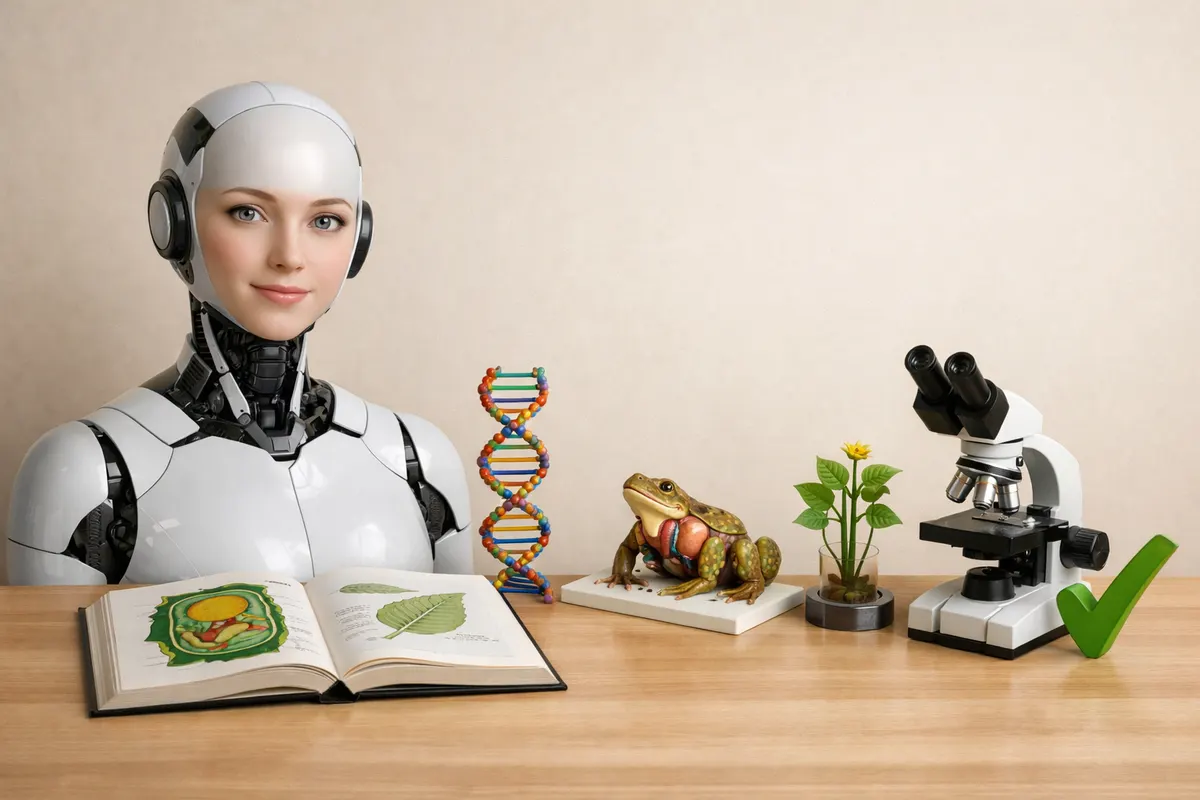
A biology tutor AI can turn a clear photo and a focused question into a structured step-by-step explanation for many observational problems. For example, if you submit a well-lit image of a leaf and ask for venation patterns, the AI can identify whether venation looks parallel, pinnate, or palmate, then explain why that distinction matters for classification or function. Similarly, a photo of a microscope slide with labeled structures can let the AI walk through which organelles or cell types are visible, what staining highlights, and how to interpret relative size and shape in the image.
The tool also helps translate visual data into reasoning steps you can learn from. If you show a growth curve, gel photo, or field plot, a biology tutor AI can describe observable trends, common sources of experimental error visible in the image (bubbles, smeared lanes, scale inconsistencies), and a plausible sequence of calculations: how to estimate rate, normalize intensities, or convert pixels to micrometers when a scale bar is present. That stepwise approach is the main value—teaching the method so you can reproduce or check the work yourself.
For homework-style questions, the AI is especially useful when you need a guided method rather than a single asserted answer. It can propose hypotheses consistent with the photo and suggest the next visual checks to narrow options: compare leaf underside, look for stomata, note cell wall thickness, or re-photograph with a scale. When source data are visible and the question is constrained, a biology tutor AI will often produce a correct, teachable path from observation to conclusion.
- Identify clear visual categories: leaf venation, cell types, gross anatomy features.
- Explain measurement steps when a scale bar or known object is present.
- Point out visible experimental artifacts that affect interpretation.
- Turn images into a reproducible checklist: what to measure and why.
What a biology tutor AI cannot prove from a photo
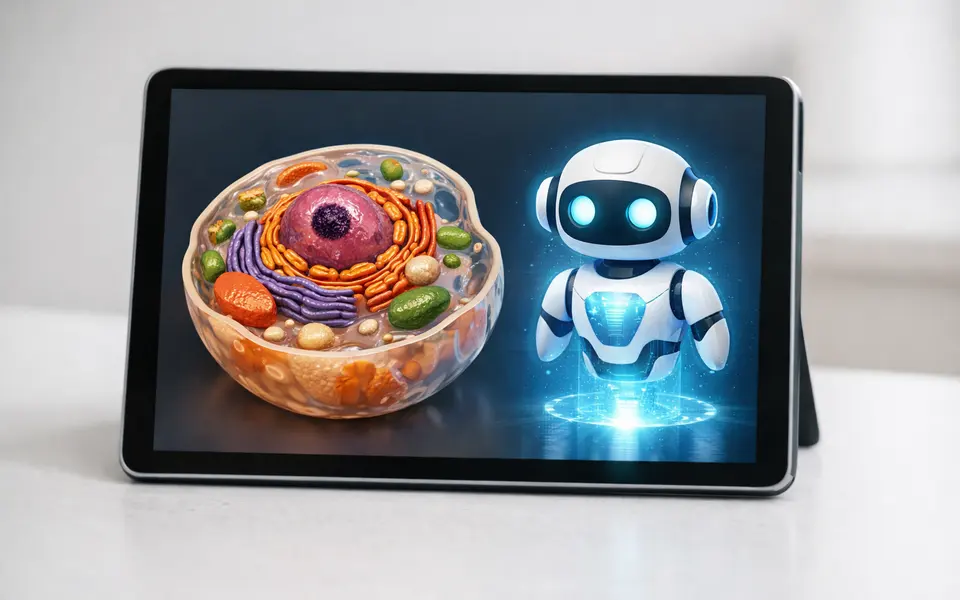
No AI can prove biochemical identity, purity, or clinical status from a photograph alone. A picture cannot confirm DNA sequence, species-level identification for cryptic taxa, chemical contamination, or sample viability. If a question requires molecular, chemical, or physiological evidence—PCR, mass spectrometry, cultures, or bloodwork—an image-backed AI answer remains provisional. Treat any definitive-sounding claim about identity, toxicity, nutritional content, or value as a hypothesis that needs independent testing.
Photos are also a poor source for inferring internal states that lack visible markers. For example, you cannot reliably tell age in many organisms, exact disease progression, or genetic mutations simply by surface appearance. Even high-quality microscopy images can be ambiguous: similar staining patterns may arise from different protocols or cross-reactivity. The AI might suggest the most likely interpretation based on visible cues, but it cannot replace targeted assays, controlled experiments, or expert confirmation.
Finally, automated tutors can mislead if the input photo lacks context. A close-up of plant hairs could look like glandular trichomes or fungal hyphae unless the app sees surrounding features, a clear scale, or multiple angles. When the dataset behind the AI contains bias or limited training examples for rare organisms or uncommon preparations, the system can propose confident but incorrect matches. Always treat AI output as a guided hypothesis, not a final certification.
- Cannot confirm DNA, chemical composition, or species when visual cues overlap.
- Cannot prove toxicity, edibility, or clinical diagnosis from images alone.
- Cannot guarantee accuracy for rare taxa or novel experimental artifacts.
- Cannot replace lab assays, cultures, or professional identification.
Visual clues to photograph for a biology tutor AI
Good photography increases what an AI can explain. Prioritize sharp images, consistent lighting, and multiple perspectives. A single, blurred close-up hides context; a pinned specimen photo without scale makes size estimates impossible. Capture at least one image that shows the subject next to a common object (ruler, coin) or include a scale bar, and take additional shots from different angles: whole organism, mid-range, and close detail of the diagnostic feature.
Focus on stable morphological traits rather than color alone. Color shifts with white balance and lighting, so emphasize structures that persist across photos: venation patterns on leaves, arrangement of floral parts, number and placement of appendages, cell wall thickness, and texture. For microscopy, include an image with the objective magnification noted or a calibration slide; mention staining method and whether the preparation is fresh or fixed. These details let the AI convert pixels into interpretable units and avoid over-weighting color as the sole clue.
Contextual metadata matters. Add short notes about habitat, behavior observed, or sample preparation: was the plant collected along a roadside, in freshwater, or in a salt marsh? Was tissue fixed with ethanol, stained with methylene blue, or photographed under polarized light? That context helps the AI narrow possibilities. When possible, indicate the instrumentation (stereo microscope, compound microscope, phone camera model) and any known constraints so the AI can adjust its reasoning for resolution, depth of field, and expected artifacts.
- Include scale: ruler, coin, or microscope magnification noted.
- Take multiple views: whole specimen, habitat, and diagnostic close-ups.
- Note preparation: staining, fixation, fresh/frozen, or dried sample.
- Prefer structural traits (venation, segmentation) over color alone.
- Record instrumental context: lens magnification and lighting type.
How to verify biology tutor AI answers step by step
Start with simple, noninvasive checks you can do quickly. Rephotograph the subject with a scale and a different light source; a small change often reveals whether surface color or texture was an artifact. Cross-check the AI’s suggested diagnostic features against a trusted field guide, lab manual, or textbook image. If the AI gave a multi-step method—for example, how to estimate stomatal density—repeat those measurement steps yourself to confirm the intermediate numbers before accepting the conclusion.
When uncertainty remains or the stakes are higher, move to routine lab or classroom verification. For identification questions that matter (conservation, regulated species, or invasive organisms), compare multiple independent specimens and consult a specialist or local herbarium/collection. For structural claims from microscopy, replicate the staining or mounting and examine more fields of view to rule out sampling error. For biochemical or genetic claims, plan the appropriate assay: protein gels, enzyme assays, PCR, or sequencing—each provides evidence that images cannot.
Use experts and controlled tests for final confirmation. Contact a teacher, local extension service, or a certified lab when the outcome has legal, health, or financial consequences. Share the AI’s reasoning and the images so the human reviewer can evaluate the same clues; the combination of AI-guided checklist plus human judgment shortens verification time. Keep records of raw photos, metadata, and the stepwise checks you performed so you can reproduce the verification if needed.
- First re-check visually: new photos with scale and different lighting.
- Replicate the AI’s measurement steps before trusting numeric results.
- Use field guides, manuals, and multiple specimens to reduce mis-ID risk.
- Escalate to lab tests (staining, PCR, chemical assays) for conclusive proof.
- Consult teachers, extension agents, or certified labs for high-stakes cases.
Related guides
Use BiologyAI to check the steps, not to skip them
Try BiologyAI on your phone to turn photos into a step-by-step checklist: get guided measurements, suggested follow-up photos, and clear verification steps. Treat the app’s explanations as a learning tool—replicate the calculations, re-take photos with scale, and escalate to lab tests or an expert when results affect safety, grading, or legal outcomes. Install the app to practice the method and build confidence before you rely on any single automated answer.


Frequently asked questions
How accurate is a biology tutor AI for homework or study help?
A biology tutor AI is a useful study companion for method and step-by-step reasoning: it can show how to interpret an image, set up a calculation, or identify common features. Accuracy depends on photo quality, context, and whether the question requires molecular or chemical proof. Treat the AI’s output as a guided solution you should replicate and verify rather than a final answer to hand in without checking.
Can I use pictures of organisms to get a definitive species identification?
Often you can get a good candidate list for species-level ID, especially for well-documented, distinctive organisms. However, lookalike species, juvenile stages, and cryptic taxa frequently require specimen dissection, genetic testing, or expert comparison. Use the AI’s suggestions as leads—collect more diagnostic views, consult authoritative keys, or send samples to an expert when species certainty matters.
Are there privacy or ethical considerations when sharing photos with an AI tutor?
Yes. Remove identifiable personal data from images (faces, license plates) and avoid sharing images where location could put endangered species at risk. If the photo involves labs, patient material, or proprietary research, follow institutional data policies. When in doubt, anonymize metadata and consult your instructor or supervisor before sharing.
What should I do if the AI and my textbook or teacher disagree?
Use disagreement as an opportunity to follow the AI’s steps and verify each intermediate claim. Re-run measurements, gather more photos, and cross-reference authoritative sources. Present the AI’s reasoning and your verification attempts to your teacher or TA—this collaborative approach quickly reveals whether the conflict stems from an ambiguous image, a misapplied method, or a genuine conceptual difference.